

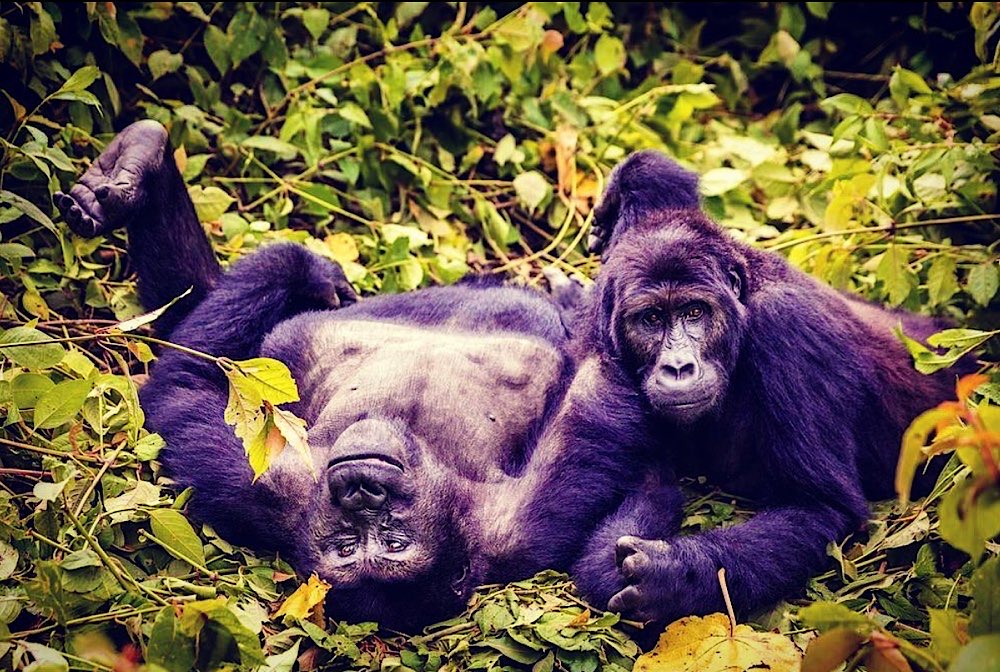
Mountain gorillas inhabit the highlands of Uganda, Rwanda and DR Congo. They evolved half a million years ago, with the rise of the Virunga volcanoes, adapting to the terrain by diverging from other eastern gorillas, becoming bulkier and hairier.
They are herbivores who sometimes eat ants and termites. They tend to eat in the morning and in the afternoon and travel 1-2km (1mi) in search of suitable nesting sites.
Mountain gorillas use vocalisations, physical gestures and movement to communicate. Their contact grunts are very important for group cohesion and coordination.
Females reach sexual maturity at eight years and mate with some or all males in the group. Pregnancy is 8.5 months and there are 3-4 years between births. At birth they weigh 1.5-2kg (4lb) and after four months ride on their mother’s back.
A silverback is an adult male, over 12 years old, with a distinctive patch of silver hair on his back and large canine teeth. He is the group leader, makes all the decisions, mediates conflicts, leads them to feeding sites and is responsible for defence, safety and well-being.
Discovered in 1902, their groups consist of 10-20 members and they live 30-50 years. There are only about 1,000 mountain gorillas in existence but their number is increasing. They can be visited in four parks: Rwanda’s Volcanoes NP, Uganda’s Bwindi and Mgahinga NPs and Congo’s Virunga NP.
Kahuzi-Biega NP is the only place in the world where habituated Eastern lowland gorillas (also known as Grauer’s gorillas) can be seen. The biggest of all gorilla subspecies, Grauer’s males grow to almost two metres (6 feet and 5 inches). They have shorter hair than mountain gorillas. It is estimated that there are about 3,500 of them left on the planet.
featured image: silberback mountain gorilla in Mgahinga Gorilla National Park by Jiro Ose
Our Stories About Gorillas:
-

Can Primate Parachuters Be Responsible Tourists?
If our goal is to make travel in the Gorilla Highlands region more responsible, what do we do with Primate Parachuters?The Primate Parachuter (PP) shall be a provisional term for a tourist who is only interested in seeing mountain gorillas, and maybe chimps. For many PPs, time in Rwanda/Uganda is severely limited, usually because this…
-
Is Tracking Gorillas Ethical?
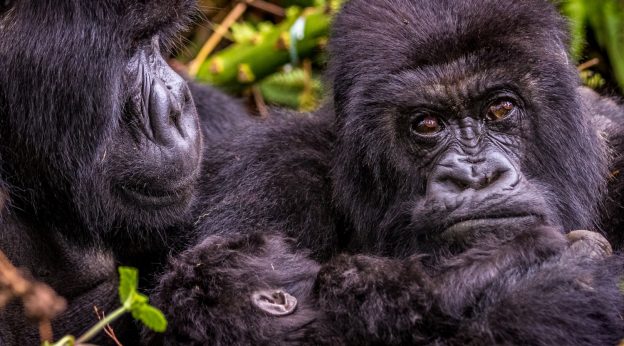
105mm, f/3.2, 1/400s, ISO1600 Questions like this are tricky, mainly because only one of the parties involved — that would be us, the humans — can truly understand what’s happening and why. Let us explain …Mountain gorillas were almost extinct by the early 1980s, and only a concerted conservation effort brought them back from the…
-

SABA Episode #12 — Gorilla Tracking in a Local Helicopter & Other Questions
It wasn’t our original plan to have the 12th episode of SEE AFRICA BREATHE AFRICA limited to Mgahinga Gorilla National Park. But then we ran into obstacles getting gorilla tracking clients and park officials from Rwanda and Congo to join Tuesday’s Zoom call, and adjusted a bit …To listen to the 26 information-packed minutes of…
-
Are Rwanda and Uganda Suitable for Travelling with Kids?
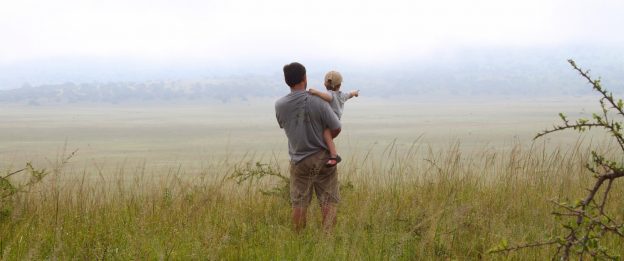
Travelling with children anywhere requires a little bit more planning and preparation. A safari with kids is no different, but it is certainly very possible. A trip to the Gorilla Highlands region need not be ruled out or put on hold until kids are older …A visit to Akagera National Park, like many typical safari…
-

SABA Episode #5 — Grauer’s Gorillas, Bonobos & Community Issues
With this fifth episode of SEE AFRICA BREATHE AFRICA we achieved something pretty monumental: we recorded everything but the Voice of Santa Barbara live, at once! Before we would always have to add extra recordings to what we get on the Tuesday Zoom call. That wasn’t easy for me — I’ve been doing studio sessions,…
-

Our Gorilla Trek Well Beyond Gorillas
Strange enough, it all started in Prague.It was summer 2009, my wife Marta and I were in town for our vacations, and decided to pay a visit to the local zoo.That was the first time we had the chance to meet face to face with the gorillas, and we spent more than an hour marvelling at…
-

We Were Ready for a Gorilla Battle
Members of the Gorilla Highlands Experts global community, something special happened in Uganda’s Bwindi today! Something that I really need to share with you …I have been a ranger for 12 years, taking visitors to gorillas in both Bwindi and Mgahinga national parks — and yet I had never seen anything like that! You know,…
-

Never Gets Old
70mm, f/5, 1/250s, ISO400As much as we try to focus on highlights, attractions and activities other than gorilla tracking, this remains — undeniably and deservedly — the region’s top drawcard. I am fortunate enough to have lost count of the number of occasions I have been out with gorillas. My first time wasn’t exactly conventional. Near…
-

Slapped by a Gorilla: 30 Ultimate Hiking Images
We are back into lockdowns and travel restrictions throughout the Gorilla Highlands region, so we remember last month especially fondly.May 2021 was the go-time for nine eager Dutch boys to fy into Uganda, tired of the one-year wait for their Ultimate Hike — a combination of Volcano Quest and Parks Reunited — to finally take…