

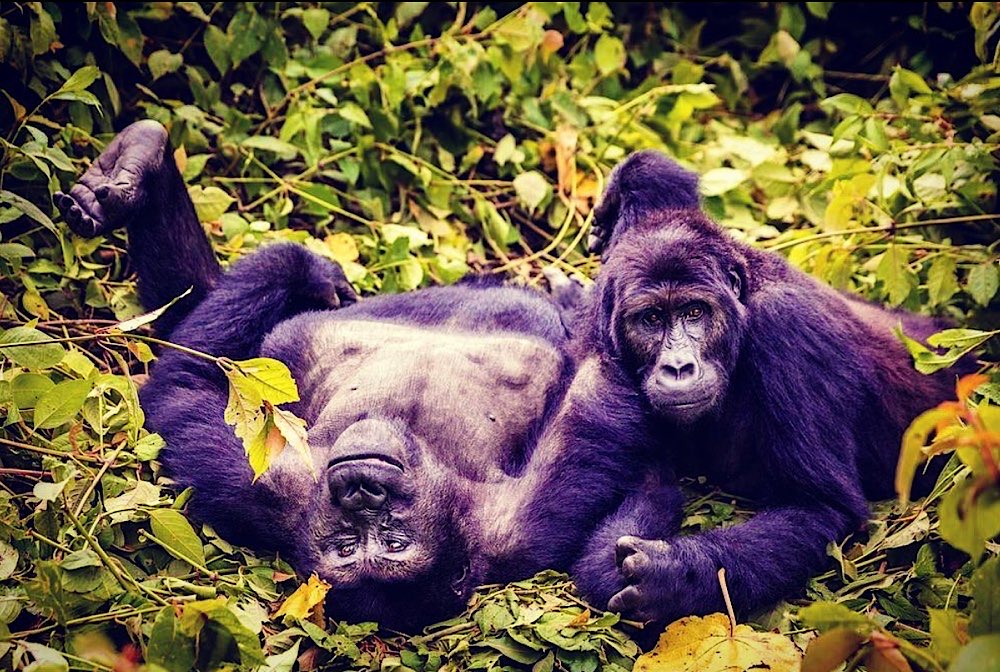
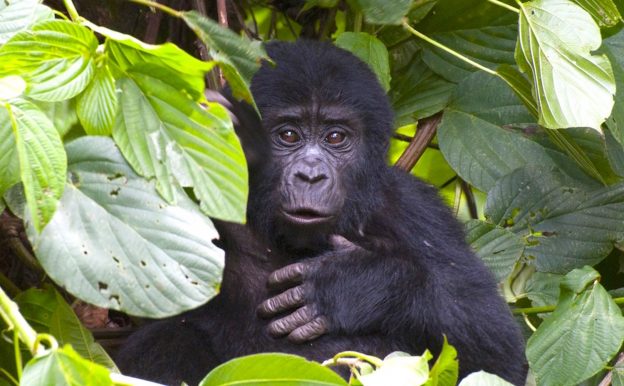
Mountain gorillas inhabit the highlands of Uganda, Rwanda and DR Congo. They evolved half a million years ago, with the rise of the Virunga volcanoes, adapting to the terrain by diverging from other eastern gorillas, becoming bulkier and hairier.
They are herbivores who sometimes eat ants and termites. They tend to eat in the morning and in the afternoon and travel 1-2km (1mi) in search of suitable nesting sites.
Mountain gorillas use vocalisations, physical gestures and movement to communicate. Their contact grunts are very important for group cohesion and coordination.
Females reach sexual maturity at eight years and mate with some or all males in the group. Pregnancy is 8.5 months and there are 3-4 years between births. At birth they weigh 1.5-2kg (4lb) and after four months ride on their mother’s back.
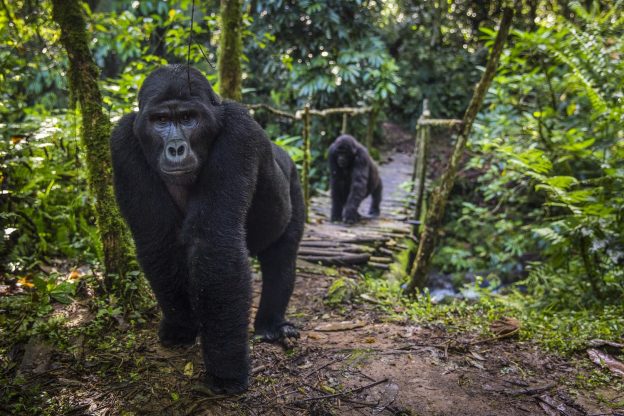
A silverback is an adult male, over 12 years old, with a distinctive patch of silver hair on his back and large canine teeth. He is the group leader, makes all the decisions, mediates conflicts, leads them to feeding sites and is responsible for defence, safety and well-being.
Discovered in 1902, their groups consist of 10-20 members and they live 30-50 years. There are only about 1,000 mountain gorillas in existence but their number is increasing. They can be visited in four parks: Rwanda’s Volcanoes NP, Uganda’s Bwindi and Mgahinga NPs and Congo’s Virunga NP.
Kahuzi-Biega NP is the only place in the world where habituated Eastern lowland gorillas (also known as Grauer’s gorillas) can be seen. The biggest of all gorilla subspecies, Grauer’s males grow to almost two metres (6 feet and 5 inches). They have shorter hair than mountain gorillas. It is estimated that there are about 3,500 of them left on the planet.
featured image: silberback mountain gorilla in Mgahinga Gorilla National Park by Jiro Ose
Our Stories About Gorillas:
-

The Godfather and the Controversial Martyr of Mountain Gorilla Research
The first scientist to study mountain gorillas full time in the wild was George Schaller. When he reviewed the literature he could find few verifiable facts, largely due to the secretive lifestyle of the gorilla in dense forest and bush. In 1959 he chose a research area in Kabara (DR Congo) because of its more open habitat,…
-

Showered Siblings
500mm, 1/400s, f/4, ISO800Well, this takes me back quite a few years! My first gorilla experience was actually in DR Congo, in Virunga National Park. I had just spent a few weeks in Uganda, where I met Miha and a few other members of the Gorilla Highlands team who are still part of the project…
-

Were Batwa Really Dangerous to Gorillas?
The sad story of the Batwa “Pygmies” of the Gorilla Highlands reached its dramatic peak when they were kicked out of national parks. This was in line with the traditional view of conservation — nature can only be protected in strict separation from indigenous peoples — but was that actually needed? Were they truly dangerous to gorillas?Dian Fossey, the…
-
How Do Gorillas Get Habituated (Used to Humans)?
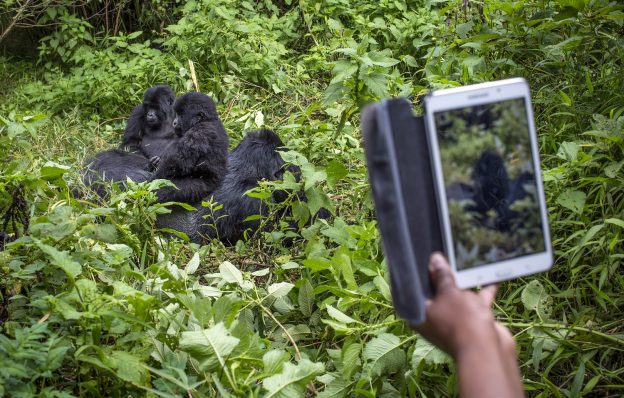
In the national parks of the Gorilla Highlands, many gorilla groups roam. But only some of them can actually receive one-hour visits from tourists. That is because they are habituated or, in other words, used to humans.This is done very selectively and carefully. For example, when in 2017 Rwanda doubled its gorilla tracking fees from…
-

Big 1
500mm, 1/500s, f/4, ISO500I’m not sure if you have come across the New Big 5 Project: basically, an initiative to come up with, obviously, a new big five. The old big five list — lions, elephants, buffaloes, rhinos and leopards — actually originated with hunting, as they were considered the most dangerous of Africa’s wild…
-
Why Do Gorillas Fart So Much?
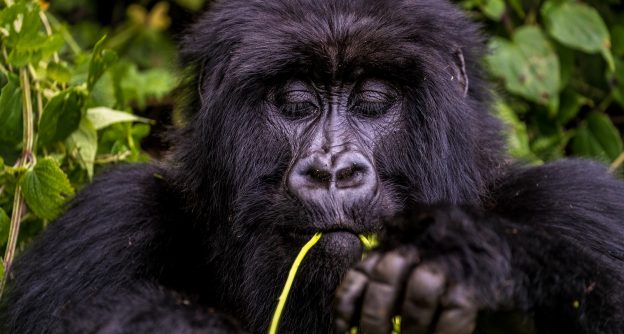
Contrary to old myths about bloodthirsty gorillas hunting humans, mountain gorillas are peaceful vegetarians. What Do Mountain Gorillas Eat? They are herbivores, eating up to 140 different types of fruit, herbs, stems and roots. Like other primates they sometimes munch on ants and termites and have been seen to enjoy a communal meal off a favourite…
-
Marhale and His Gift of Joy
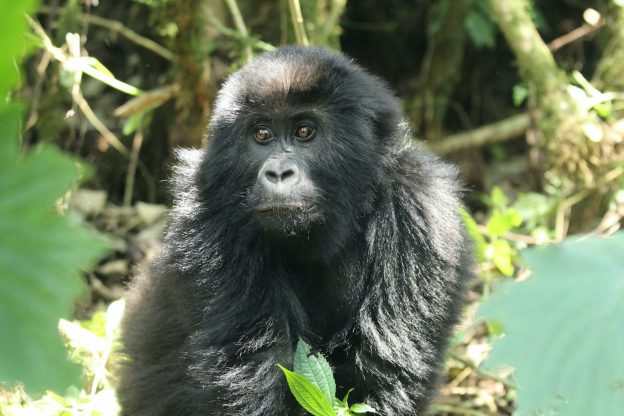
One of the most rewarding parts of studying the social behaviour of animals is getting to know individuals and watching their personalities come through. For gorillas, we begin identifying each one using a variety of characteristics, such as unique nose prints, ear shape, and scars. For example, notice the notches on Pilipili’s ear and the…
-
How Human are Gorillas?
Researchers are often struck by gorillas’ apparent humanity. Taking into account our genetic similarities of 95% or above, there has been a long debate about how close humans and gorillas really are.George Schaller — one of the world’s most preeminent field biologists —travelled to the Virunga Volcanoes in the 1960s, at age 26, to study…
-
Dawn of Gorilla Tracking as a Tourism Activity
While there were sporadic non-scientific expeditions to mountain gorillas before, real tourism began with the arrival of Walter Baumgartel. Baumgartel was a German who had lived in South Africa, helped the British with reconnaissance photography during World War II, and eventually found an enticing ad in London: they were looking for somebody interested in a…